Daily Practice
Morning Routine
Every(*) morning, before work, I spend 30-60 mins studying. My basic routine is to make my tea, sit down at my desk, open the Mango Languages app and then do:
- Farsi
- Spanish
- Swedish
- French
in that order. If I run out of time, I finish what I can then stop and start the next day. I’m a little bit behind on French, comparatively, but not terribly. Because Farsi involves technically learning two things (both the spoken language but also the script), sometimes that takes longer than others.
I only do one single unit for each language, then I do the review. The review varies in size, and depends a lot on how many days since my last review. At one point I think French had something like 60 cards (words/phrases) pending; usually it’s closer to 10-15.
* OK not every morning
Taking Notes
I started off using looseleaf paper and writing down, line by line, in three columns: english, pronunciation, then the foreign equivalent. No particular intentional reason behind this other than that when I started with Farsi, which is written Right-to-Left, it made more sense to put the Farsi-script words starting on the right-side. That convention just stuck for the rest of the languages.
In the pronunciation, I use a quasi-phonetic form, with capitals for emphasis. Typically, this is transcribed directly from whatever Mango Languages has, though sometimes I will make an editorial decision to modify it somewhat. The Swedish module, in particular, is very lax with the phonetics here. I’ve sent Mango Languages feedback:
To: Mango Languages Support Team
Date: 4 Dec 2025
…(snip!)…
Last, the Swedish phonetic pronunciations could be written better. They are often written exactly as the word, whereas in the Spanish and French phonetics, they are written with more granularity. particularly around vowel sounds.
In swedish in particular, the solitary word pronunciation (when i press on the word itself to see its phonetics) even the audio is different (cf. “jag” in context of “Jag heter Kurt” — in the sentence, and in the phonetic, it shows (IIRC) “jag” but the sentence uses the shortened “yah” and pressing on the word uses the more literal “yahg”). Also, I swear that “How’s it going” is used interchangeably with “Hur är det till” och “Hur står det till” – should be some clarification there. Given that the phonetic descriptions of words in the other languages I’ve worked with (Spanish, Farsi, French) all use anglophone-oriented phonetics, the swedish one shouldn’t be any different: “yah” instead of “ja” or “jag”; “teel” instead of “till”; “day” or “deh” for “dig”, etc. Having an option to enable IPA phonetics would be even better, but since that’s it’s own thing to learn, that should definitely be optional.
and they responded:
Date: 4 Dec 2025
…(snip!)…
Finally, about the Swedish phonetics: we will make a note about that feedback you mentioned and we’ll see what we can do.
So far I’ve not seen a change, so I’ve continued to just use my own judgement about it.
Improving Notes
Initially, my notes were just “write each word / phrase as it comes in, without repeating”, top-to-bottom, but using separate pages for each language. The pages were numbered for reference (Español 1, Español 2, Farsi 1, Farsi 2, etc.), and I kept them in loose piles on the table. After a couple weeks of this, it got a bit cumbersome and papers were getting mixed up / misplaced.
The first thing I did was spend a study session going through the words and putting a key letter next to each one indicating a general grouping. This was my schema:
- N: noun
- A: modifier (adjective, adverb, preposition, conjunction, etc).
- D: date / time, but also numbers (for now – these need to be broken out)
- V: verbs, any tense including infinitives
- P: proper nouns (names, countries, anything that would be capitalized in english. Farsi only has names, but I need to move other proper nouns to it)
- G: greetings / conversational protocol language
- C: counting, numbers (this was broken out specifically for Farsi)
After assigning these labels, I transcribed all the lines over to pages that would only have one of those categories, each. So “Español N1”, “Español N2”, “Español V1”, “Español G1”, etc.
This did make it use up a lot more paper, but it made it much easier to find the words I needed to, and also helped some patterns / roots become more apparent, particularly with verb tenses.
It was neat to see how the pedagogical emphasis differed for each language. Here is the current line counts:
| Language | N | A | D | V | P | G | C |
|---|---|---|---|---|---|---|---|
| Farsi | 51 | 45 | 7 | 35 | 21 | 9 | 29 |
| Spanish | 30 | 32 | 31 | 35 | 14 | 10 | 11 |
| Swedish | 72 | 58 | 2 | 34 | 11 | 11 | 1 |
| French | 20 | 22 | 25 | 27 | 2 | 20 | 0 |
French is under-represented because of the reasons I mentioned earlier.
Swedish and Farsi both put a strong emphasis on nouns and modifiers. All of them introduce verbs at a similar pace. I found it interesting how much more conversational protocol languages (“G”) category was present for French, though, even despite me lagging behind on that one.
Swedish has, so far, been almost completely disinterested in discussing dates or numbers! I think I’m a unit behind on French so there may be a “number” unit coming up.
I didn’t break this out into its own category, but Swedish definitely over-represented both family words and also academic words in the “N” category. I would say probably 1/3 of the words I have there are in those 2 groups. Spanish and French focused a lot on the weather and on seasons. Farsi dove into commerce pretty early. This isn’t necessarily a commentary on any cultural customs, but I find it interesting that each language would frontload words in these categories.
Further Improving Notes
The abundant amount of looseleaf I was now managing was becoming a problem. I had a binder from prior Farsi practice but that felt a bit too bulky for now. I picked up a few folders that had brad-inserts so they could hold looseleaf. Honestly, I was having flashbacks to middle school, but it works.
I chose different colors so they’d be easy to identify (based loosely on colors in their country flags, though I was very limited on what colors I had available to choose from). Green = Farsi, Yellow = Spanish, Red = French, Teal = Swedish.
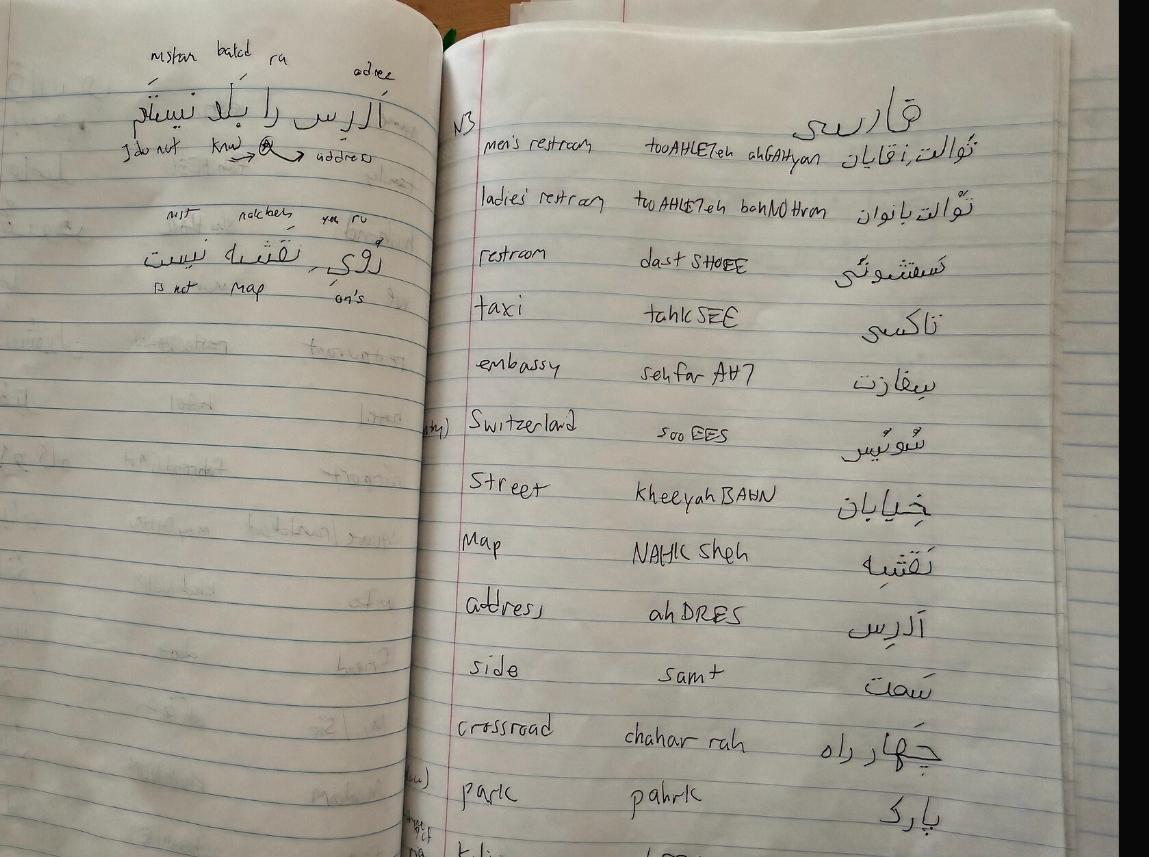
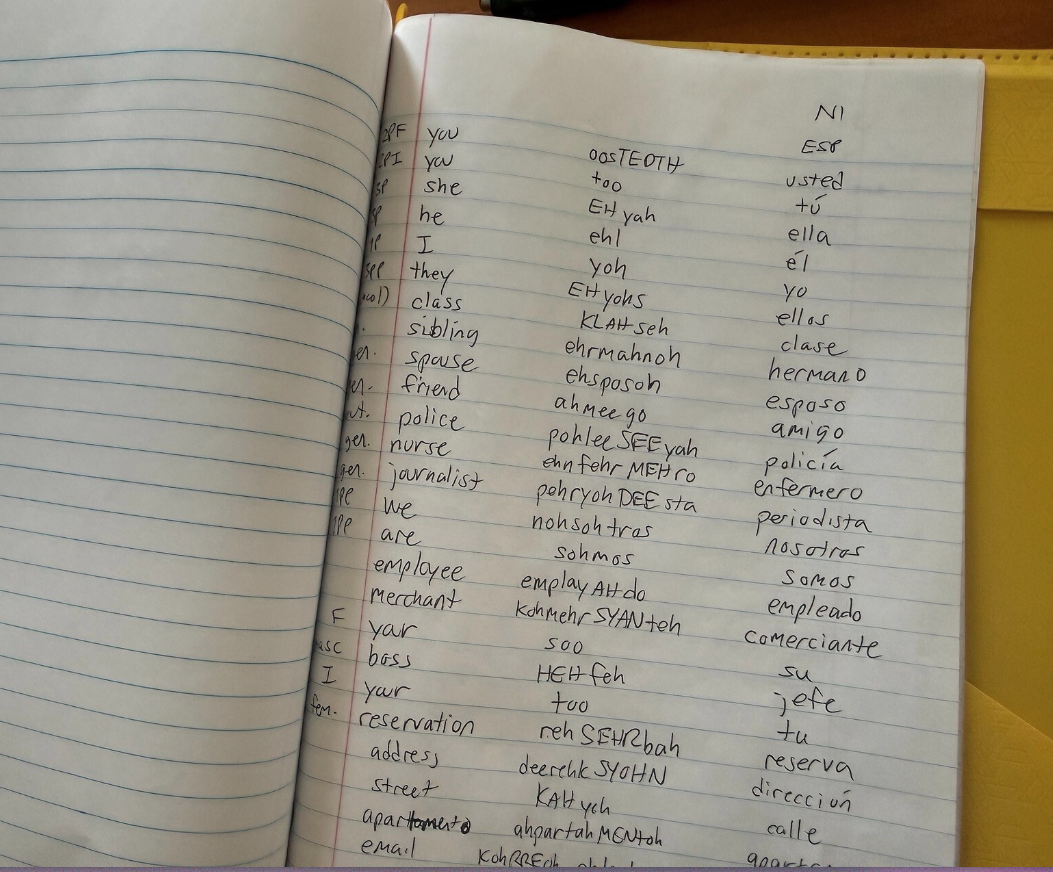
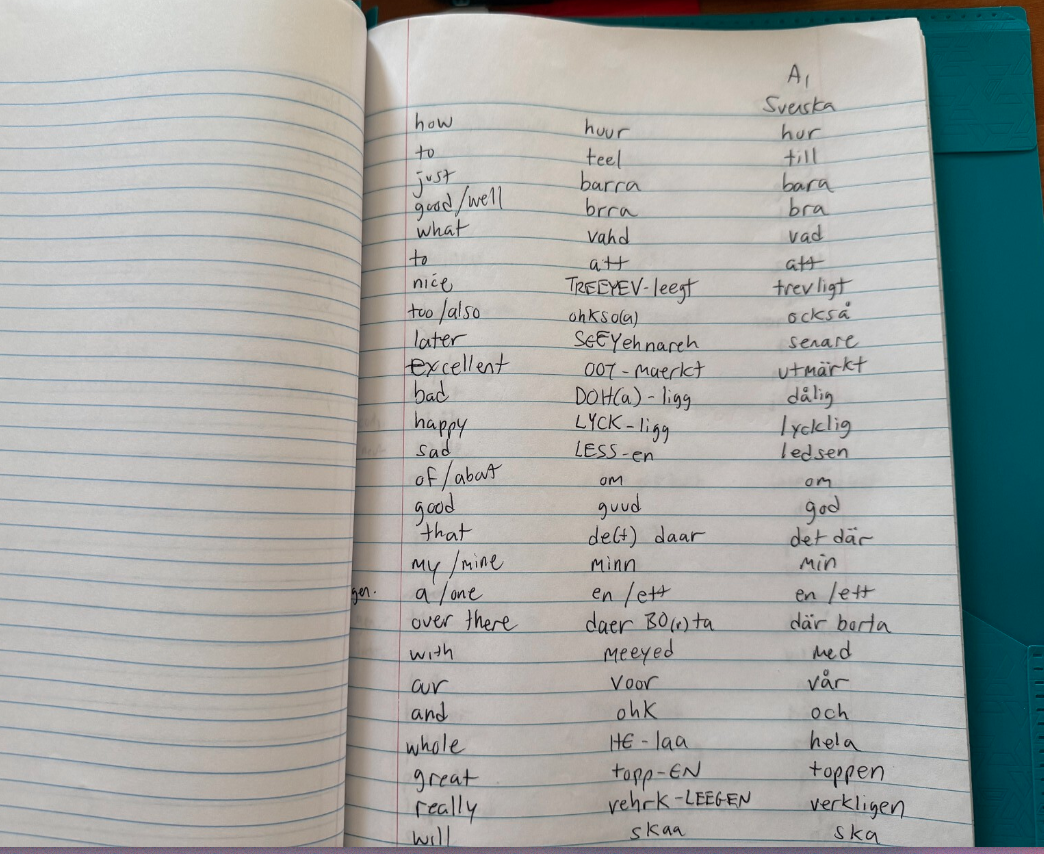
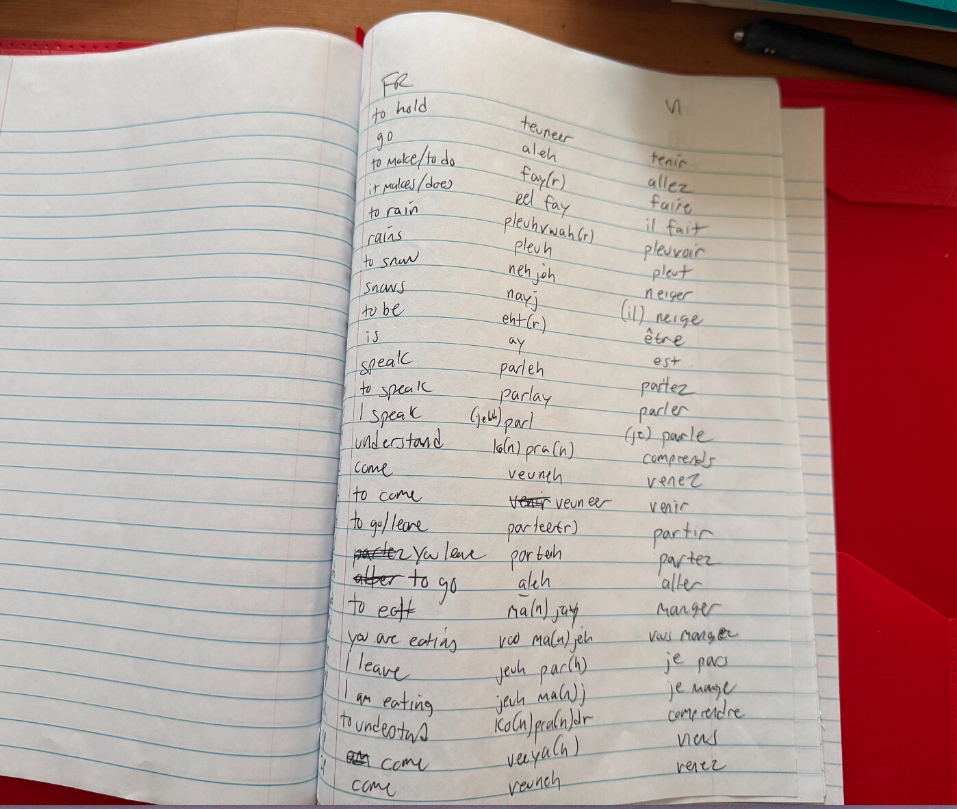
I added each section, with a single blank piece of looseleaf after it, into each of their respective folders.
This has made it a lot easier (and kept my desk a lot cleaner) to switch from language to language.
When I’m doing my reviews, if I forget a word, I can quickly flip to the section and find it much more quickly. I may add section flags as well, to make this even faster.